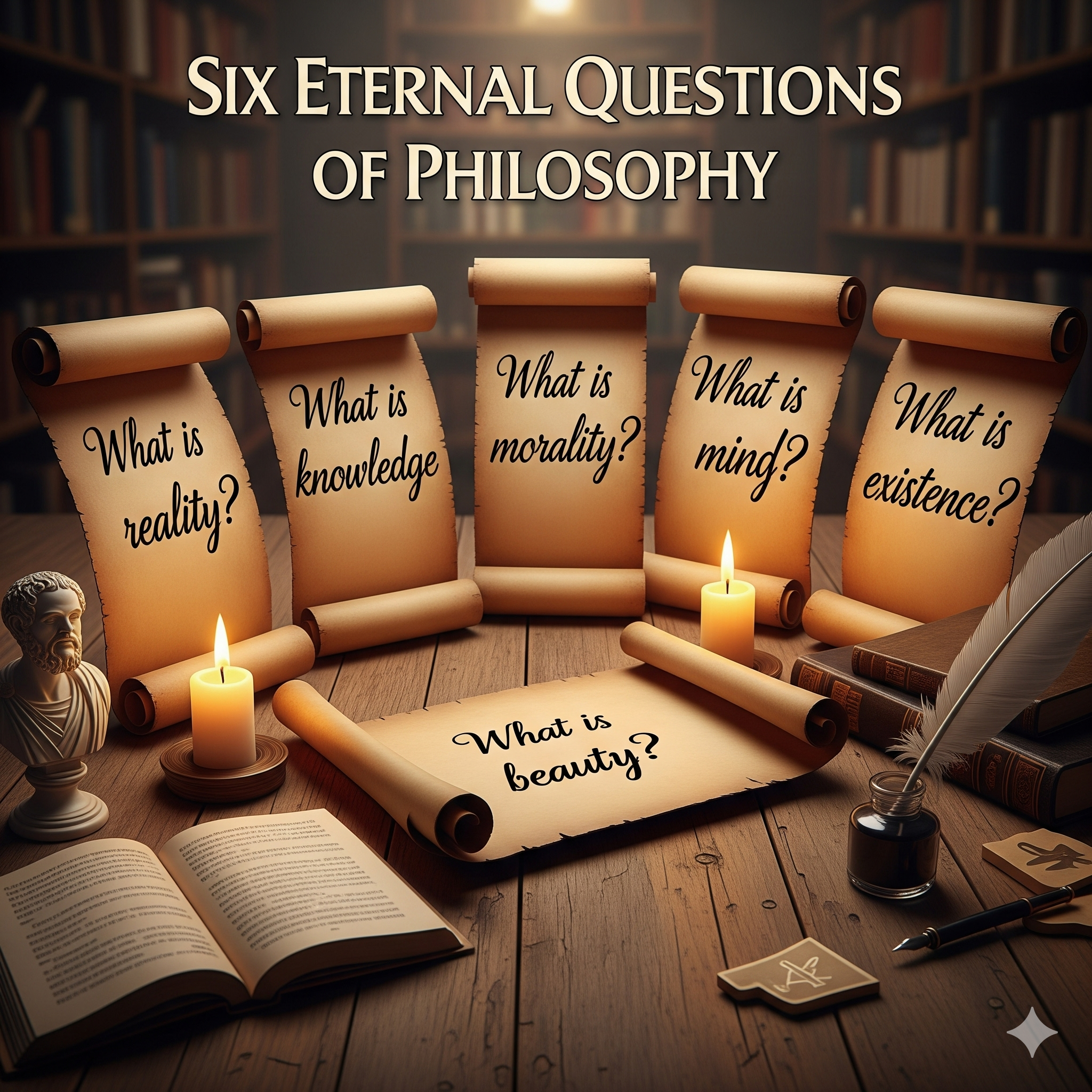
Philosophy begins with questions—deep, unsettling, and timeless. From ancient Greece to modern times, thinkers have wrestled with the same mysteries. Here are six of the most fundamental questions and the ways philosophers, religions, and scientists have tried to answer them.
1. Who am I?
This is the question of self and identity. Some traditions say we are immortal souls (Plato, the Upanishads). Others argue we are defined by consciousness and thought. Descartes famously declared, “I think, therefore I am.” Modern science often sees the self as a product of the brain and experience.
2. Where did the world come from?
Early Greek philosophers like Thales believed the universe arose from a basic element—water, air, or fire. Religious traditions teach that God or a creator brought the world into being. Modern cosmology suggests the universe began with the Big Bang nearly 14 billion years ago.
3. Has the world always existed, or was it created?
Aristotle and some scientists argued that the universe has no beginning, that it has always been. Most religious views hold that the cosmos was created at a certain moment by a divine power. The debate between eternity and creation continues even today.
4. Are there laws behind nature?
Science assumes yes: the laws of gravity, thermodynamics, and evolution govern how reality works. Philosophy asks whether these “laws” are truly part of nature or just human descriptions of regular patterns. Either way, searching for order in chaos has been central to human thought.
5. Do we live on after death?
Religions and spiritual traditions teach that the soul survives—through heaven, rebirth, or liberation. Materialist thinkers like Epicurus and Marx argued that death is the end of consciousness. Existentialists such as Sartre insisted that death is final, and that life’s meaning must be created here and now.
6. How do we know what we know?
This is the core of epistemology, the study of knowledge. Empiricists like Locke and Hume said knowledge comes through experience and the senses. Rationalists like Descartes and Spinoza claimed it comes through reason and logic. Kant tried to unite both, arguing that the mind actively shapes our experience of the world.
Conclusion
These questions remain unanswered, and perhaps they always will. Yet that is the point of philosophy—not to close the mystery, but to keep the conversation alive. Asking “Who am I?” or “What is real?” is not just abstract theory; it is the way we discover meaning in our own existence.
Views: 1
Yo, DK999login is pretty new to me, but the login process is super easy. Looks promising! Check it out dk999login, maybe you’ll have better luck than I do getting a win!
Pk777xs is a good one, lads! Give it a look! Seems pretty reliable. See for yourself pk777xs.
Kicked back with kl991 for a bit. It’s alright, nothing super special but a solid option I reckon. Give it a shot kl991.