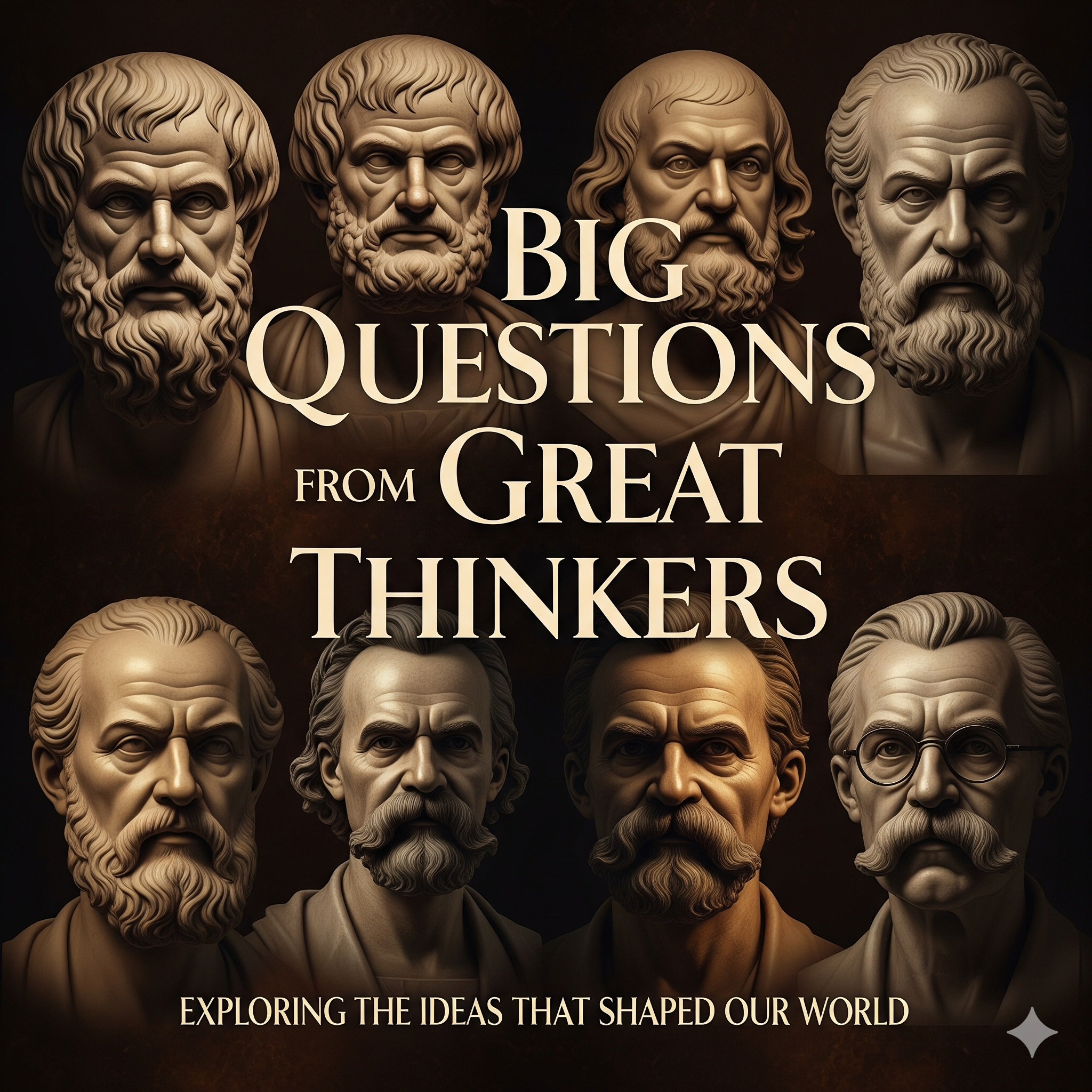
The history of Western philosophy is a fascinating journey, beginning with early Greek thinkers who asked fundamental questions about the universe, and continuing through modern times with ideas that still shape how we see life, society, and ourselves. Let’s take a walk through the lives and thoughts of some of the most influential philosophers.
Thales, Anaximander, and Anaximenes
These three early Greek thinkers, known as the Milesians, were among the first to search for the natural principles behind existence. Thales believed that water was the basic element of all things. His student Anaximander suggested the idea of the “infinite” (apeiron) as the source of everything. Anaximenes thought air was the fundamental substance. Their ideas mark the birth of rational inquiry in the West.
Parmenides and Heraclitus
Parmenides argued that reality is unchanging and that change is only an illusion. In sharp contrast, Heraclitus believed that everything is in constant flux, famously saying that one cannot step into the same river twice. Together, their ideas raised the eternal tension between permanence and change.
Democritus
Known as the “laughing philosopher,” Democritus introduced the theory of atoms—that everything is made of tiny, indivisible particles. This materialistic view of the universe influenced later scientific thinking.
Plato and Aristotle
Plato, student of Socrates, developed the theory of Forms—perfect, unchanging ideas beyond the physical world. His works still shape discussions of justice, politics, and metaphysics. Aristotle, his student, took a more practical approach, emphasizing observation and categorization of the natural world. His contributions to logic, ethics, and science dominated Western thought for centuries.
Augustine and Aquinas
With the rise of Christianity, philosophy merged with theology. Augustine explored the relationship between faith and reason, shaping early Christian doctrine. Centuries later, Thomas Aquinas combined Aristotle’s philosophy with Christian theology, building a powerful framework for medieval thought.
Descartes, Spinoza, and Leibniz
In the 17th century, rationalism took center stage. Descartes, famous for “I think, therefore I am,” emphasized reason as the foundation of knowledge. Spinoza saw God and nature as one, developing a bold and systematic philosophy. Leibniz introduced the idea of “monads” and believed that we live in the best of all possible worlds.
Locke, Berkeley, and Hume
The empiricists argued that knowledge comes from experience. Locke spoke of the mind as a “blank slate.” Berkeley claimed that reality exists only as it is perceived. Hume took skepticism further, questioning causation and the certainty of knowledge.
Kant and Hegel
Kant tried to bridge rationalism and empiricism, arguing that the mind actively shapes experience. His “Critique of Pure Reason” remains one of philosophy’s most challenging works. Hegel later developed a philosophy of history and spirit, describing progress through a dialectical process of thesis, antithesis, and synthesis.
Kierkegaard, Marx, Darwin, and Sartre
The 19th century opened new paths. Kierkegaard focused on individual faith and the anxiety of choice, laying the groundwork for existentialism. Marx analyzed society through the lens of class struggle, influencing politics and economics worldwide. Darwin, though primarily a scientist, profoundly changed philosophy by introducing the theory of evolution, challenging traditional ideas of human nature. In the 20th century, Sartre carried existentialism forward, declaring that humans are “condemned to be free,” responsible for creating their own meaning.
Conclusion
From the earliest Greeks searching for the substance of reality to Sartre’s call for personal freedom, Western philosophy has continuously evolved, reflecting humanity’s deepest questions. These thinkers shaped not only academic philosophy but also politics, science, religion, and culture. Their legacy reminds us that philosophy is not just abstract thought—it is a conversation across centuries about what it means to be human.
Views: 2